Friday, November 4, 2011

Future Maps

Im in a really cool digital media seminar this semester.... it has got me obsessed with AFFECT and affect theory..... we are reading lots of books but I got a real great kick out of this one in particular...  

Grace Jones' Corporate Cannibal 

Steven Shaviro’s Post Cinematic Affect aims to validate the conception that “films and music videos … are best regarded as affective maps, which do not just passively trace or represent, but actively construct and perform, the social relations, flows, and feelings that they are ostensibly “about” ”(Shaviro, 6). However, I contest his assertion by proposing that affective mapping does not represent the present but constructs the future and reveals how a conception of the present is no longer obtainable. The present is fragmented and in a constant state of fluid change. This would also hold that not only subjective emotion has waned as Shaviro would suggest but also affect. For how could it hold true that affect has not waned when our tools for subjectively understanding and interpreting affect are predetermined by affective mapping?
Affective maps do not and cannot give voice to sensibilities whilst they construct instructional paradigms for distilling emotion from affect. The paradox of the indeterminable audience/consuming public is that the public’s desires, just like affect, cannot be quantified, calculated, or determined. Thus, in a consumer society there is never a demand for new products. Demand is created through marketing strategies. Affective mapping reveals only how we should feel and respond to affect, while simultaneously showing us the future we are being programmed to desire. Main stream post-cinematic representations can only be productively expressive, “productive in the sense that they do not simply represent social processes but actively inform/constitute them”(Shaviro, 2). 

                  materiality's basis does not consist of coins

When Shaviro describes affect as the “ambient, free-floating sensibility that permeates our society today” (Shaviro, 2) he seems to be referring to a desire to make sense of the information around us by conforming to the reception of non-subjective responses, post-cinematic affect becomes characterized by desire and acquisition. The perfect example of this is the film Scott Pilgrim vs. the World; the movie makes no logical sense in and of its own, its affect is derived from a certain predetermined understanding remembering, or investment in a certain culture. As audience members we either connect or disconnect: either you get the joke or you feel nothing and we want to feel so we learn the jokes. Thus, revealing that when our subjective emotion has waned so too does our ability to be affected. Since the masses desires can never be quantified or understood mass production of entertainment seeks only to gratify itself, the myth of representation in mass media lies in that it does not exist.
The human mind and body are now in constant fluctuation, shifting eternally on screens: human identity and psychology is changing in response to digital constructions. In a constant state of montage subjective identity and perception of emotions are morphing no longer tied to an indexical point of reference/referent but a fluctuation of symbols and response cues. Human psychology adapt in response to dominant media’s representations; what it feels like to live today should be changed to: how it should feel like to live in the early twenty-first century”(Shaviro, 2).

                              ^^^(cognitive map)^^^

Affective maps are a testimony to our fragmented present and fragmented sense of subjective emotion. If the cognitive/affective experience relies on very specific sets of emotional triggers, affect is transformed into gratification or diverted by disconnection. Mass media does not represent anyone: rather they project what a control society wants us to be like, in such a way films only inform us how to think and feel. Affective maps are  projections for future identification. Since there is no way to know the public reception audience and because of globalization of media, the subject and affect are predetermined. As a result BOTH have waned and are in a constant state of waning. The future of human psychology is being written by moving images on screens.
-MJJ

Monday, October 31, 2011

My Wild and Raunchy Deep Space Adventures on Planet 69


Does any one else remember when those stupid metallic leggings and wearing plugs became super popular?
Nik Haskin's My Wild and Raunchy Deep Space Adventures on Planet 69 is a pastiche film made by a bratty quasi-rebelious-middleclass-guy- it relies heavily on visually quoting Tim and Eric, paint, and a green screen. As well as gay jokes.I was informed that the title is a play on Ed Wood's Plan Nine From Outer Space and the gay comic My Wild and Raunchy Son.  It is about a gay porn star couple that live on various media platforms and universes in space and time and their dream to create the greatest porn ever.... 


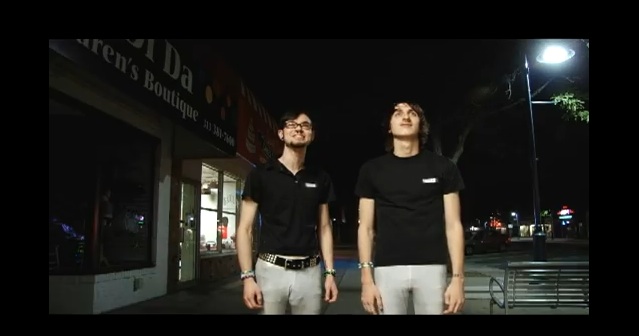
Once more- that is to say: yet another cultish independent film- this time not by a member of the university community (like it makes a fucking difference- equally or less stupid than my last film reviewed- just goes to show maybe college DOES make you stupid...)- made in Michigan- saw this one in a basement in Allen Park- it was made by the guy with the glasses and black hair...


What I really liked about the film (much to the dismay of one of the animators- Arthur Muzzin) is that it plays out like a high and or just plain mundane channel surfing experience- except there is something interesting on every channel- so here is where you can choose to watch the trailer and be dissapointed in the future (if you even EVER get the experience of watching the movie) or go by my description of the film and then be forced to go on the youtube everyday for the rest of your life hoping the dvd has been taken out of Arthur's basement and uploaded to the internet:


according to my interpretation it plays out a lot like Schodinger's cat:
there are four rooms with televisions: 
1.some kids getting stoned
2. An elderly couple
3. over sexualized video gaming room 
4. guy jacking off 
in room three the kids are playing a video game starring Chip and Dale, 
in room one they are flipping through channels where they get infomercials and some cartoons, room two monotonous candle screen, room four Chip and Dale also star in porno 


I think if you disregard the plot the director/writer was going with and instead of trying to make narrative sense out of the film it is a great historical document as a reflection of my generation of psuedo-cool early 2000 over sexualized internet fiends with tight pants and plugs- love for owls and cartoon network allusions. One of my biggest problems with legitimate/mainstream films is that they do not represent the consuming audience- this film shows you who made it and who would want to watch it-


*as a side note: if everyone in the movie was actually gay this might be important art... alas... 
watch at your own risk:
The official trailer to the much anticipated "scifi sexploitation" film entitled: My Wild and Raunchy Deep Space Adventures on Planet 69 (aka Planet 69).
                                                                                                                                                       -MJJ

Sunday, October 30, 2011

Vince Noir

I'm kind of obsessed with Noel Fielding's character -in British comedy troupe The Mighty Boosh -Vince Noir. Vince's look consists of sparkling one piece suits, platform shoes, pointy boots, women's accessories, and topped off with voluminous hair he looks like a cross between David Bowie and Joan Jett. I can't help but be reminded of myself in his character because of his obsession with fashion and his constant longing to reinvent himself. Throughout the show Vince jumps from fashion fads like mod, goth, punk, glam, and so on in an attempt to mock fads and how vapid youths approach them.

I'm also impressed by how actor Noel Fielding takes on these crazy roles like old greg and howling jimmy jefferson, the costumes are hilarious and heavy loaded with wigs, make-up and always glitter -it cracks me up.
 "Whatchyou doin' in my waters? I'm Old Greg"
Howling Jimmy Jefferson


Love those shoes, he makes me want to move to London

Its like Vince says "I can never be unhappy in a poncho"


Hail Mary-Photographed by Andrew Whitton

The infamous silver jumpsuit Vince's signature look
 
These photos don't really prove my point.... JUST WATCH THE DAMN SHOW!

-Mink Stygian 

Wednesday, October 26, 2011

Enduring Destiny


If Tommy Wiseau and David Lynch where retarded-film-making-siamese-twins-conjoined-at-the-head, and some how obtained eight thousand dollars and then managed (at least partially) to maintain the dedication of a cast and crew for at least three years- the end product would be Enduring Destiny


The story of "Max Kenner" (Thomas Reilly-King), scholarship wrestler and aspiring C.I.A. agent, has traveled from his suburban California home and high school sweetheart, "Jessica Bateman" (Ariel Vida), to a bitter cold semester at Michigan State University. There unfolds a gripping, coming-of-age journey into the glory days of youth and timeless memories. Personalities intermingle in a mix of triumphs, romance, comedy, mishaps, and downright misery. Once a squeaky clean, slightly cocky guy of privilege and self determination, is thrust into a humbling life of physical dependence after tragedy strikes. As a cripple in a wheelchair, Max's masculinity becomes confronted by his reliance on others. Jealousy and ulterior motives surface through a landscape filled with fast-paced fraternity parties and superficiality galore. Also starring Shae Valko as nerdy roommate, "Bernard Feinstein", Nick Zott as Max's fraternity big brother, "Jake Conway", Zack Stewart as the wrestling team bully, "Sid Butcher," with special appearances by Russ "Rusty" Jameson and the one and only Mr. Bill Vincent. Enduring Destiny is a deconstruction into a status-driven ego of crippling proportions. You'll laugh, you'll cry, you'll witness one young man's fire burning deep inside!
-T.R.K.
Drama / Suspense

Independent Feature-length Film

Filmed in High Definition


I recenty had the priviledge ( I say this both ironically and genuinely: I genuinely feel like part of a privileged elite after having been able to see this movie!) to watch a rough cut- what might be the second to last cut before the final product- of the film Enduring Destiny at a mutual friend of T.R.K. and mine's house-  [the missing shots are filled in with intertitles describing the shot and it's narrative function]


it may be "the text book example of how not to make movie"-it is ludicrous- but the fact that I had heard so much about it before hand made for a sort of fabricated cult viewing experience of which my generation (the youtube generation) has sadly been stripped of on account of the availability and convergence of media-


(my synopsis: a jock form California moves to Michigan to go to MSU (presumably on a wresting scholarship) to follow his destiny and become-yes at MSU- a CIA agent- he leaves behind his high school girlfriend- arrives in snow to greet his nerdy/cute roommate- whom he abandons for popularity when he joins a fraternity- there is lots of wrestling- an evil ginger nurse- a guy with green hair- an Obama mask- a sledge hammer- falling wheelchairs- retribution-a CIA agent- more wrestling-) all you have to know is that in T.R.K.'s universe it takes two hours to drive from California to Michigan.
-MJJ


I had written more but it got deleted on these fucking stupid library computers so this is all i have to say for now. 

Wednesday, September 21, 2011

Blaxploration 80's Dichotomy

There is a fine line drawn in African American music of the 80's, a dichotomy delineated by the vapid work of say- musicians like Lionel Ritchie and his "Dancing on the Ceiling" on one hand and Public Enemy's provocative rhetoric in "Right Starter" (both released in 1987). In 1989 Trey Ellis writes "The New Black Aesthetic" a partial but endearing cultural observation of the new African American culture, he optimistically makes reference to the changing landscape of culture arising from a post civil rights generation of new artists, and the importance of stressing blackness as a medium of progress. He specifically critiques Ritchie and Whitney Houston as"- pop singers [that] have transformed themselves into cultural-mulatto, assimilationist night- mares; neutered mutations instead of thriving hybrids. Trying to please both worlds instead of themselves, they end up truly pleasing neither" (Ellis, 242) on a basis that they have "applied Porcelana fade cream to their once extremely soulful throats". Which is where I draw the line, I don't think its about how you sing the song or the tune rather the nature of the lyrics or the purpose- or inversely lack there of. The fact that "Dancing on the Ceiling" is a song about getting wasted and having fun while "Right Starter" is a sort of social manifesto and critique as a response to crime and repression in/of African American communities.


When it comes to music, especially African American music, its really difficult to say it is multi cultural- in my perspective African American music has a privileged cultural position in the 20th century- because to a certain point most white/American/British popular music has somehow developed from it. So in an effort to place PE in the matrix of what Ashe coins the post soul aesthetic music is put in a paradoxical place: where electric guitars in the 80s reference punk 70s and garage rock 60s, which are "white" music but influenced by African American music like Bo Didley or Little Richard, or Muddy Waters... the list goes on and on-the point is rebellion in white culture has just been ripping of African Americans-so as I was saying the question rises: is Public Enemy's music culturally mullato- my answers is yes. And no. In a sense that there is a twisting genres and conventions in which it is culturally seen as reflecting punk attributes, I mean yes it is perceived as a hybrid. But it does not consciously adopt attributes from white music.         


Personally what really resonates for me about "Right Starter" and Public Enemy is the sort of “taking back what’s ours” idea through music- its like punk was never white but we (youth, musical fanatics) associate it with British and American/Detroit/NY/CA bands- I mean its about this means of expression through music that is always taken back by commercial culture and re articulated as a white product-history is compressed, its made out to be like its teenagers and young adults that are unhappy-sort of the colorblind argument except it goes deeper here- its not egocentric existential dilemmas or love- its more rudimentary- its INJUSTICE. It is such a burden to carry such a great discourse that it would be impossible not to revert to nationalistic tones to make a point- so don't take it personally. As one fan puts it: “With Yo! Bum Rush the Show, Public Enemy introduce a new kind of bravado that's not just directed at other players and sucker MCs but is an out-and-out middle-finger challenge to the whole world”. So in that sense its questionable if their music can be considered mulatto. But I don't personally feel that it’s so important that a work is a cultural fusion- that doesn’t always make it progressive.

            What Public Enemy definitely does do is trouble blackness: on one hand hip hop slang and sartorial display have been associated with mainstream African American pop culture for as long as it has existed but they don't have the same discourse as a lot of their contemporaneous musicians. Rather their lyrics clearly and poetically articulates a discourse:

 Our solution, mind revolution
Mind over matter, mouth in motion


As the world turns, it's a terrible waste
To see the stupid look stuck on your face
Time bomb alarm for the world, just try it
Known to all zones as the one man riot
I'm on a mission to set you straight
Children, it's not too late
Explain to the world when it's plain to see
To be what the world doesn't want us to be  

(Right Starter)
 

I first heard their music in Spike Lee's "Do the Right Thing"


In such a way, Public Enemy does what Ashe coins as allusion disruption- the song is an allegorical mock of the hip hop public, by musicians catering to an audience perceived as holding certain values glamorized by their predisposition to older hip hop; that creates a fragmentation form old school hip hop. It may initially sound like old school but it definitely isn’t. Where old school hip hop was say- to come back to the analogy- more like Lionel Ritchie's "Dancing on the Ceiling" -without the Porcelana fade cream Trey Ellis was talking about. That had come to define African American music of the era. Or more so anticipated bands such as PE. What I'm getting at is that Lionel Ritchie's songs and Grandmaster Flash and the Furious Five's songs carried the same messages more or less, while one was pop and the other was hip hop, then what could be said was the entertainers message to black mainstream culture was vapid and PE was a shift of what was expected. By questioning the stereotypes represented by both pop and hip hop- thus troubling blackness.


What is amazing to me is that there is a constant palpitating vitality in the legacy of Public Enemy, a sort of poetic tendency that has been inherited by new hip hop/rap musicians such as Odd Future's Tyler the Creator.  It’s still a social commentary; very post modern and convoluted but important. Simultaneously fully conscious of historicity and its responsibility as a social document to reflect in an ironic but moving way something people know but usually repress such as poverty, racism, or crime.  

Saturday, September 17, 2011

Pigs

NYFA 2009: the assignment was to use continuity editing to make a music video on 16mm, so I bought a pig mask and a cd of The Cure at a local shop, borrowed a saw and some blood and wrote this out: 


-MJJ

Wednesday, August 31, 2011

Songs About Pussy

I personally don't find animals especially sexy but I can see why the cat is a sex symbol- I think it has to do with the purring and sleek movement... maybe the fit form...  the bestiality part kinda freaks me out but I mean to each his own, I'm sure most people don't think about it at all, they probably think pussy meant vagina before it did cat... kids these days... 

Either way I guess the linguistic association must have somehow evolved from the Ancient Egyptian symbol for the goddess of carnal pleasure and women: Basthet.. I'm sure you've seen her around.
But then again its origins seem German, specifically the Old Saxon word for vulva pūse, which also coincided with, but not synonymous for the call for a cat: "puss"...  in Taiwan the Amis word for cat is pusi...Eskimos say pussi... the list goes on.. If I took a wild guess I'd say it has to do with onomatopoeia- hiss hiss hiss anyone? phonetic association? maybe. I could go into the etymology... okay maybe if you're that interested you should be studying linguistics- so the last thing I'm going to say about pussy is that in medieval French pucelle referred to a young adolescent girl or a virgin or something and vulgarly became the synecdoche: puce referring to women....

...there are quite a few songs I really like that are about sexy cats so here you go:

 ^^^^^^^^^^^
this song is originally by April Stevens, her version is way better but I didn't want to make this post about her so I'm going to use the Marlyn Monroe version for the sake of variation..
 

 April Stevens has the sexiest purr, it sends shivers down my spine...
okay one last thing .. the "sex cat" thing has been attributed to two films 1958 And God Created Woman and 1964 film Kitten With a Whip's protagonists Bridgitte Bardot & Ann-Margret... so they can probably be held responsible for bringing it into the mainstream of pop culture 


everybody wants to be a cat...


                                                         -MJJ